
NEWS+ · CONNECTIVITY & OPPORTUNITY
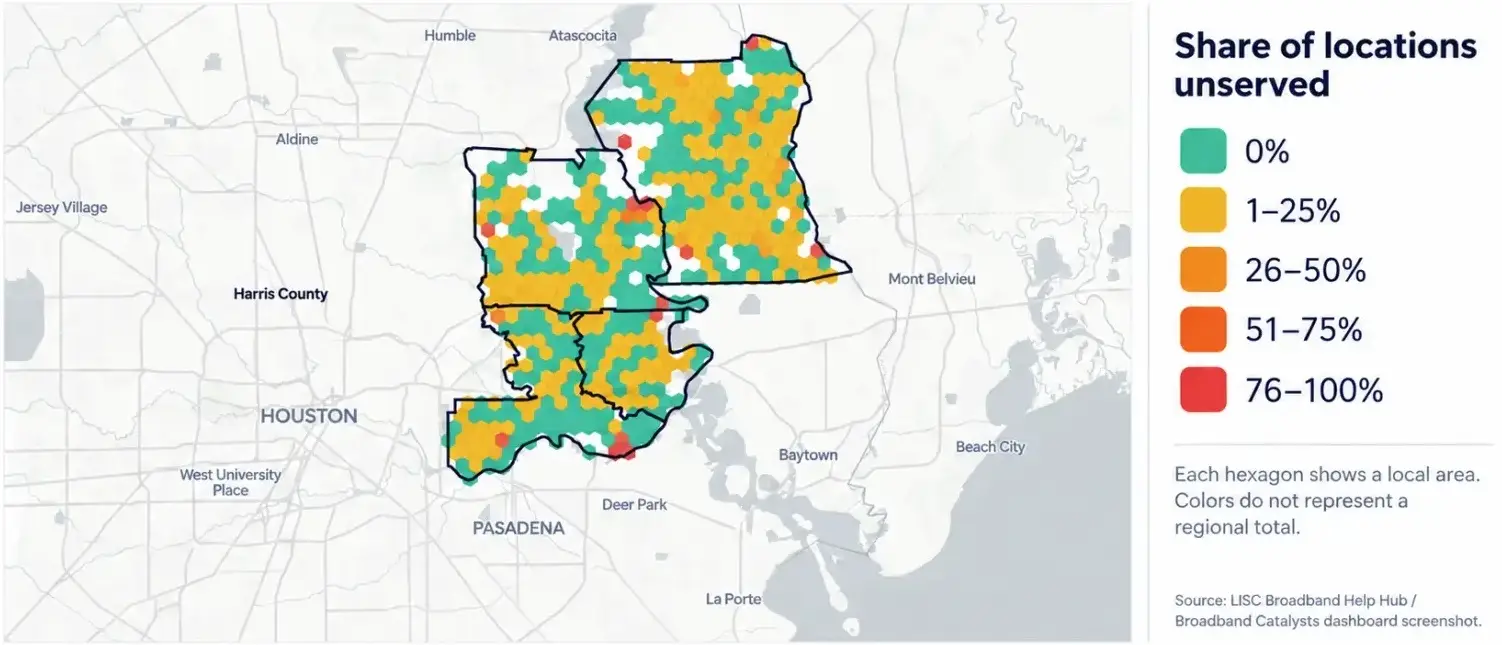
Yellow means some places are still left out.
Internet companies say they serve most places in the yellow areas, but some places still cannot get service.
East Harris County’s future depends on whether the people who live here can access the opportunities around them. Economic growth needs intentional investment to become community opportunity.
Reliable, affordable internet is part of that foundation. It helps a student finish homework, a parent apply for a job and a neighbor connect with a healthcare provider.
With technical assistance from LISC’s Broadband Help Hub and Broadband Catalysts, EHCEC now has an interactive dashboard and maps to help us understand where gaps remain and bring partners together.
Why we are investing in closing the digital divide
As a regional development organization, EHCEC brings partners, data and community needs together to guide long-term investment. We are investing in this work because families need reliable, affordable internet to learn, work and connect with resources.
Closing the digital divide starts with understanding where gaps remain. It also means listening to families about cost, devices and the support they need to get online. Regional progress takes intentional investment and shared responsibility. We are building that foundation together.
EHCEC is investing time, partnerships and planning capacity in this work because we see a significant need to close the digital divide. Access to opportunity increasingly depends on having an affordable, reliable connection, a usable device and the skills to navigate online services. Families should be able to complete schoolwork, apply for jobs and connect with resources from home.
What the regional data tells us
EHCEC’s regional dashboard shows that some households across every district area still lack home internet. The 2024 American Community Survey five-year estimates presented in
East Harris County: The Opportunity Gapshow:
| School district area | Households without home internet |
|---|---|
| Channelview | 7.5% |
| Crosby | 7.4% |
| Galena Park | 4.6% |
| Sheldon | 5.7% |
| Harris County comparison | 5.7% |
Channelview and Crosby have higher estimated shares than the county comparison. These figures show why connectivity deserves regional attention, while also reminding us that needs vary across places. They do not tell us why each household lacks internet or establish that small differences are statistically significant.
Source: EHCEC, East Harris County: The Opportunity Gap, September 2026; 2024 ACS five-year estimates (2020–2024), as displayed on the Our Region dashboard. Figures describe school district areas, not individual city boundaries, and are separate from the LISC broadband coverage analysis.
What the LISC work adds
The dashboard helps us look more closely at internet access across Channelview, Crosby, Galena Park and Sheldon. Most locations have reported service, but some places are still left out.
What we learned
- There are still gaps to close. The dashboard identifies 794 unserved locations and 90 underserved locations. These can include homes and businesses.
- Big numbers can hide small pockets of need. Providers report that 98.6% of locations are served. The maps help us see the places still left out, including gaps shown in yellow.
- Options depend on where you live. Providers do not all reach the same places. Some locations rely on older DSL connections that may need a replacement as that service is retired.
For EHCEC, these findings help us ask better questions, listen to residents and bring partners together around places that need attention. A connection also needs to be affordable and useful in everyday life.
Source: Marco Map dashboard for EHCEC; FCC provider-reported data dated December 31, 2025, exported June 23, 2026. These are service locations and reported availability, not a count of families connected. The household estimates above come from the ACS.
How this guides our next steps
- Understand the options. Use the dashboard to identify where fixed and mobile broadband providers report service, then examine affordability and residents’ experiences.
- Focus outreach. Look for places where connectivity barriers overlap with other needs and consider trusted community locations for digital skills support.
- Coordinate with providers and partners. Use the maps and service information to support informed conversations about access and future investment.
- Track change. Review broadband expansion and funding information, including BEAD award data when available, to understand planned provider activity. The June deliverable recommended this step; it did not confirm specific local projects or awards.
EHCEC’s investment in this foundation reflects a clear priority: closing the digital divide so more residents can use the opportunities available to them. Better data helps us direct attention and build partnerships around that need.
Explore your region
Use the dashboard to take a closer look at broadband availability across East Harris County. Check the source dates and geography when interpreting the results: provider-reported availability does not establish whether a household subscribes, can afford a plan or consistently receives a reliable connection.
How to use the dashboard
- Open the dashboard. Select “Explore the Broadband Dashboard” above. It opens in a new tab, so you can return to this guide.
- Start with the region. Confirm that you are viewing the East Harris County Empowerment Council report. This project covers the four school district areas used in the regional analysis; city, community, ZIP and district boundaries differ.
- Explore the Broadband tab. The project presentation identifies this tab as the place to see providers reporting service in the area, the number of broadband-serviceable locations they serve and the technologies they use.
- Read the maps alongside the information. Explore reported coverage and provider information together. Check the selected geography and source date before comparing places or quoting a figure.
- Understand what a location means. A broadband-serviceable location is a location used for broadband availability reporting. It is not a count of people, subscribers or households that EHCEC has connected. Provider location counts should not be added together as a unique regional total because service areas can overlap.
- Consider your own connection. Use the separate internet quality test linked above if you want to explore your current connection. A test reflects conditions at that time and does not by itself explain why a connection is slow.
Keep in mind
Reported coverage does not guarantee service at a specific address, an affordable price or the speed you will receive. Confirm address availability, current plans and pricing directly with a provider. If a dashboard control or label has changed, use the current on-screen labels; the guide is based on the project team’s June 2026 presentation.
Built through partnership

Thank you to LISC’s Broadband Help Hub and Broadband Catalysts for providing the technical assistance, dashboard, mapping files and broadband education resources delivered to EHCEC in June 2026. Together, these resources create a foundation for more informed regional planning and conversations about affordable, reliable internet.
Source: Broadband Help Hub Technical Assistance Award Deliverable for East Harris County Empowerment Council, Broadband Catalysts, June 2026.